Comparing fastICA and alternating projection for binary group recovery
Matthew Stephens
2026-08-15
Last updated: 2026-08-15
Checks: 7 0
Knit directory: misc/analysis/
This reproducible R Markdown analysis was created with workflowr (version 1.7.2). The Checks tab describes the reproducibility checks that were applied when the results were created. The Past versions tab lists the development history.
Great! Since the R Markdown file has been committed to the Git repository, you know the exact version of the code that produced these results.
Great job! The global environment was empty. Objects defined in the global environment can affect the analysis in your R Markdown file in unknown ways. For reproduciblity it’s best to always run the code in an empty environment.
The command set.seed(1) was run prior to running the code in the R Markdown file. Setting a seed ensures that any results that rely on randomness, e.g. subsampling or permutations, are reproducible.
Great job! Recording the operating system, R version, and package versions is critical for reproducibility.
Nice! There were no cached chunks for this analysis, so you can be confident that you successfully produced the results during this run.
Great job! Using relative paths to the files within your workflowr project makes it easier to run your code on other machines.
Great! You are using Git for version control. Tracking code development and connecting the code version to the results is critical for reproducibility.
The results in this page were generated with repository version 57da44a. See the Past versions tab to see a history of the changes made to the R Markdown and HTML files.
Note that you need to be careful to ensure that all relevant files for the analysis have been committed to Git prior to generating the results (you can use wflow_publish or wflow_git_commit). workflowr only checks the R Markdown file, but you know if there are other scripts or data files that it depends on. Below is the status of the Git repository when the results were generated:
Ignored files:
    Ignored:    .DS_Store
    Ignored:    .Rhistory
    Ignored:    .Rproj.user/
    Ignored:    .claude/
    Ignored:    GSE87571/
    Ignored:    analysis/.RData
    Ignored:    analysis/.Rhistory
    Ignored:    analysis/ALStruct_cache/
    Ignored:    analysis/binary_quad_comparison_cache/
    Ignored:    analysis/ebproj_01.html
    Ignored:    analysis/gset_G63_cache/
    Ignored:    data/.Rhistory
    Ignored:    data/methylation-data-for-matthew.rds
    Ignored:    data/pbmc/
    Ignored:    data/pbmc_purified.RData

Untracked files:
    Untracked:  .dropbox
    Untracked:  GSE41037/
    Untracked:  Icon
    Untracked:  Rplots.pdf
    Untracked:  analysis/GHstan.Rmd
    Untracked:  analysis/GTEX-cogaps.Rmd
    Untracked:  analysis/PACS.Rmd
    Untracked:  analysis/Rplot.png
    Untracked:  analysis/SPCAvRP.rmd
    Untracked:  analysis/abf_comparisons.Rmd
    Untracked:  analysis/admm_02.Rmd
    Untracked:  analysis/admm_03.Rmd
    Untracked:  analysis/binary_quad_comparison.Rmd
    Untracked:  analysis/bispca.Rmd
    Untracked:  analysis/cache/
    Untracked:  analysis/cholesky.Rmd
    Untracked:  analysis/compare-transformed-models.Rmd
    Untracked:  analysis/cormotif.Rmd
    Untracked:  analysis/cp_ash.Rmd
    Untracked:  analysis/eQTL.perm.rand.pdf
    Untracked:  analysis/eb_power2.Rmd
    Untracked:  analysis/eb_prepilot.Rmd
    Untracked:  analysis/eb_var.Rmd
    Untracked:  analysis/ebpmf1.Rmd
    Untracked:  analysis/ebpmf_sla_text.Rmd
    Untracked:  analysis/ebproj_01.Rmd
    Untracked:  analysis/ebproj_newton.Rmd
    Untracked:  analysis/ebspca_sims.Rmd
    Untracked:  analysis/explore_psvd.Rmd
    Untracked:  analysis/fa_check_identify.Rmd
    Untracked:  analysis/fa_iterative.Rmd
    Untracked:  analysis/fastica_heated.Rmd
    Untracked:  analysis/fastica_unwhitened.Rmd
    Untracked:  analysis/flash_cov_overlapping_groups_init.Rmd
    Untracked:  analysis/flash_test_tree.Rmd
    Untracked:  analysis/flashier_newgroups.Rmd
    Untracked:  analysis/flashier_nmf_triples.Rmd
    Untracked:  analysis/flashier_pbmc.Rmd
    Untracked:  analysis/flashier_snn_shifted_prior.Rmd
    Untracked:  analysis/greedy_ebpmf_exploration_00.Rmd
    Untracked:  analysis/gset_G63.Rmd
    Untracked:  analysis/ieQTL.perm.rand.pdf
    Untracked:  analysis/lasso_em_03.Rmd
    Untracked:  analysis/m6amash.Rmd
    Untracked:  analysis/mash_bhat_z.Rmd
    Untracked:  analysis/mash_ieqtl_permutations.Rmd
    Untracked:  analysis/matrix_beta.Rmd
    Untracked:  analysis/meth_flash_01.Rmd
    Untracked:  analysis/methylation_example.Rmd
    Untracked:  analysis/mixsqp.Rmd
    Untracked:  analysis/mr.ash_lasso_init.Rmd
    Untracked:  analysis/mr.mash.test.Rmd
    Untracked:  analysis/mr_ash_modular.Rmd
    Untracked:  analysis/mr_ash_parameterization.Rmd
    Untracked:  analysis/mr_ash_ridge.Rmd
    Untracked:  analysis/mv_gaussian_message_passing.Rmd
    Untracked:  analysis/nejm.Rmd
    Untracked:  analysis/nmf_bg.Rmd
    Untracked:  analysis/nonneg_underapprox.Rmd
    Untracked:  analysis/normal_conditional_on_r2.Rmd
    Untracked:  analysis/normalize.Rmd
    Untracked:  analysis/pbmc.Rmd
    Untracked:  analysis/pca_binary_weighted.Rmd
    Untracked:  analysis/pca_l1.Rmd
    Untracked:  analysis/poisson_nmf_approx.Rmd
    Untracked:  analysis/poisson_shrink.Rmd
    Untracked:  analysis/poisson_transform.Rmd
    Untracked:  analysis/qrnotes.txt
    Untracked:  analysis/ridge_iterative_02.Rmd
    Untracked:  analysis/ridge_iterative_splitting.Rmd
    Untracked:  analysis/samps/
    Untracked:  analysis/sc_bimodal.Rmd
    Untracked:  analysis/shrinkage_comparisons_changepoints.Rmd
    Untracked:  analysis/susie_cov.Rmd
    Untracked:  analysis/susie_en.Rmd
    Untracked:  analysis/susie_z_investigate.Rmd
    Untracked:  analysis/svd-timing.Rmd
    Untracked:  analysis/temp.RDS
    Untracked:  analysis/temp.Rmd
    Untracked:  analysis/test-figure/
    Untracked:  analysis/test.Rmd
    Untracked:  analysis/test.Rpres
    Untracked:  analysis/test.md
    Untracked:  analysis/test_qr.R
    Untracked:  analysis/test_sparse.Rmd
    Untracked:  analysis/tree_dist_top_eigenvector.Rmd
    Untracked:  analysis/z.txt
    Untracked:  code/coordinate_descent_symNMF.R
    Untracked:  code/multivariate_testfuncs.R
    Untracked:  code/rqb.hacked.R
    Untracked:  data/4matthew/
    Untracked:  data/4matthew2/
    Untracked:  data/E-MTAB-2805.processed.1/
    Untracked:  data/ENSG00000156738.Sim_Y2.RDS
    Untracked:  data/G63
    Untracked:  data/GDS5363_full.soft.gz
    Untracked:  data/GSE41265_allGenesTPM.txt
    Untracked:  data/Muscle_Skeletal.ACTN3.pm1Mb.RDS
    Untracked:  data/P.rds
    Untracked:  data/Thyroid.FMO2.pm1Mb.RDS
    Untracked:  data/bmass.HaemgenRBC2016.MAF01.Vs2.MergedDataSources.200kRanSubset.ChrBPMAFMarkerZScores.vs1.txt.gz
    Untracked:  data/bmass.HaemgenRBC2016.Vs2.NewSNPs.ZScores.hclust.vs1.txt
    Untracked:  data/bmass.HaemgenRBC2016.Vs2.PreviousSNPs.ZScores.hclust.vs1.txt
    Untracked:  data/eb_prepilot/
    Untracked:  data/finemap_data/fmo2.sim/b.txt
    Untracked:  data/finemap_data/fmo2.sim/dap_out.txt
    Untracked:  data/finemap_data/fmo2.sim/dap_out2.txt
    Untracked:  data/finemap_data/fmo2.sim/dap_out2_snp.txt
    Untracked:  data/finemap_data/fmo2.sim/dap_out_snp.txt
    Untracked:  data/finemap_data/fmo2.sim/data
    Untracked:  data/finemap_data/fmo2.sim/fmo2.sim.config
    Untracked:  data/finemap_data/fmo2.sim/fmo2.sim.k
    Untracked:  data/finemap_data/fmo2.sim/fmo2.sim.k4.config
    Untracked:  data/finemap_data/fmo2.sim/fmo2.sim.k4.snp
    Untracked:  data/finemap_data/fmo2.sim/fmo2.sim.ld
    Untracked:  data/finemap_data/fmo2.sim/fmo2.sim.snp
    Untracked:  data/finemap_data/fmo2.sim/fmo2.sim.z
    Untracked:  data/finemap_data/fmo2.sim/pos.txt
    Untracked:  data/logm.csv
    Untracked:  data/m.cd.RDS
    Untracked:  data/m.cdu.old.RDS
    Untracked:  data/m.new.cd.RDS
    Untracked:  data/m.old.cd.RDS
    Untracked:  data/mainbib.bib.old
    Untracked:  data/mat.csv
    Untracked:  data/mat.txt
    Untracked:  data/mat_new.csv
    Untracked:  data/matrix_lik.rds
    Untracked:  data/paintor_data/
    Untracked:  data/running_data_chris.csv
    Untracked:  data/running_data_matthew.csv
    Untracked:  data/temp.txt
    Untracked:  data/y.txt
    Untracked:  data/y_f.txt
    Untracked:  data/zscore_jointLCLs_m6AQTLs_susie_eQTLpruned.rds
    Untracked:  data/zscore_jointLCLs_random.rds
    Untracked:  explore_udi.R
    Untracked:  output/fit.k10.rds
    Untracked:  output/fit.nn.pbmc.purified.rds
    Untracked:  output/fit.nn.rds
    Untracked:  output/fit.nn.s.001.rds
    Untracked:  output/fit.nn.s.01.rds
    Untracked:  output/fit.nn.s.1.rds
    Untracked:  output/fit.nn.s.10.rds
    Untracked:  output/fit.snn.s.001.rds
    Untracked:  output/fit.snn.s.01.nninit.rds
    Untracked:  output/fit.snn.s.01.rds
    Untracked:  output/fit.varbvs.RDS
    Untracked:  output/fit2.nn.pbmc.purified.rds
    Untracked:  output/glmnet.fit.RDS
    Untracked:  output/snn07.txt
    Untracked:  output/snn34.txt
    Untracked:  output/test.bv.txt
    Untracked:  output/test.gamma.txt
    Untracked:  output/test.hyp.txt
    Untracked:  output/test.log.txt
    Untracked:  output/test.param.txt
    Untracked:  output/test2.bv.txt
    Untracked:  output/test2.gamma.txt
    Untracked:  output/test2.hyp.txt
    Untracked:  output/test2.log.txt
    Untracked:  output/test2.param.txt
    Untracked:  output/test3.bv.txt
    Untracked:  output/test3.gamma.txt
    Untracked:  output/test3.hyp.txt
    Untracked:  output/test3.log.txt
    Untracked:  output/test3.param.txt
    Untracked:  output/test4.bv.txt
    Untracked:  output/test4.gamma.txt
    Untracked:  output/test4.hyp.txt
    Untracked:  output/test4.log.txt
    Untracked:  output/test4.param.txt
    Untracked:  output/test5.bv.txt
    Untracked:  output/test5.gamma.txt
    Untracked:  output/test5.hyp.txt
    Untracked:  output/test5.log.txt
    Untracked:  output/test5.param.txt

Unstaged changes:
    Modified:   .gitignore
    Modified:   analysis/eb_snmu.Rmd
    Modified:   analysis/ebnm_binormal.Rmd
    Modified:   analysis/ebpower.Rmd
    Modified:   analysis/fastica_asymmetric_03.Rmd
    Modified:   analysis/fastica_bm_spd.Rmd
    Modified:   analysis/flashier_log1p.Rmd
    Modified:   analysis/flashier_sla_text.Rmd
    Modified:   analysis/logistic_z_scores.Rmd
    Modified:   analysis/mr_ash_pen.Rmd
    Modified:   analysis/nmu_em.Rmd
    Modified:   analysis/susie_flash.Rmd
    Modified:   analysis/tap_free_energy.Rmd
    Modified:   misc.Rproj
Note that any generated files, e.g. HTML, png, CSS, etc., are not included in this status report because it is ok for generated content to have uncommitted changes.
These are the previous versions of the repository in which changes were made to the R Markdown (analysis/compare_fastica_altproj.Rmd) and HTML (docs/compare_fastica_altproj.html) files. If you’ve configured a remote Git repository (see ?wflow_git_remote), click on the hyperlinks in the table below to view the files as they were in that past version.
| File | Version | Author | Date | Message |
|---|---|---|---|---|
| Rmd | 57da44a | Matthew Stephens | 2026-08-15 | Fix degenerate detection, remove >0.95 col, add note on hybrid vs |
| html | f5ac45b | Matthew Stephens | 2026-08-15 | Build site. |
| Rmd | 22eead5 | Matthew Stephens | 2026-08-15 | Update comparison table: fix vPv floating point tolerance, add p |
| html | c43e3ef | Matthew Stephens | 2026-08-15 | Build site. |
| Rmd | e4ed94f | Matthew Stephens | 2026-08-15 | Add fastICA vs alternating projection comparison |
Introduction
We compare two approaches for finding binary group structure in whitened data:
Non-centered fastICA (from
fastica_centered_02.Rmd): maximizes the log-cosh objective over unit-norm weight vectors on whitened data with a row of 1s prepended as an intercept.Alternating projection: iteratively projects a binary vector onto the subspace spanned by the data, then rounds back to ±1. Specifically, each update is
v <- sign(U %*% (t(U) %*% v))where U has orthonormal columns spanning the data subspace.
Both methods receive the same preprocessed data: centered and whitened X1 with a row of 1s prepended to form X1_aug. For the alternating projection, U = t(X1_aug) / sqrt(n), which has orthonormal columns because X1_aug %*% t(X1_aug) = n * I (whitening plus centering makes the intercept row orthogonal to all whitened rows).
For each simulation setting (taken from fastica_centered_02.Rmd) we run each method from 100 random starting points and report the fraction of starts that produce a solution correlating >0.99 with at least one true group column.
Helper functions
# X is (n.comp+1) x n.  W is (n.comp+1) x n_starts (one weight vector per column).
# P = t(X) %*% W is n x n_starts (source estimates).
fastica_update = function(X, W) {
  P  <- t(X) %*% W          # n x n_starts: source estimates
  G  <- tanh(P)
  G2 <- 1 - G^2
  W  <- X %*% G - sweep(W, 2, colSums(G2), "*")
  sweep(W, 2, sqrt(colSums(W^2)), "/")
}

# X is (n.comp+1) x n.  V is n x n_starts (one binary vector per column).
# P = X %*% V / n is (n.comp+1) x n_starts (subspace coefficients).
alt_proj_update = function(X, V) {
  n <- ncol(X)
  P <- X %*% V / n           # (n.comp+1) x n_starts: subspace coefficients
  V <- sign(t(X) %*% P)     # n x n_starts: project back and round
  V[V == 0] <- 1L
  V
}

# Center columns of X, whiten to n.comp dimensions.
preprocess = function(X, n.comp = 10) {
  X <- scale(X, scale = FALSE)
  sqrt(nrow(X)) * t(svd(X)$u[, 1:n.comp])
}
Comparison functions
max_cor_with_truth = function(v, L) max(abs(cor(v, L)))

vPv_scores = function(X1_aug, V) {
  # v'Pv = ||X1_aug v||^2 / n  for each column of V (binary +-1 vectors)
  colSums((X1_aug %*% V)^2) / ncol(X1_aug)
}

# Gradient-only step: omits the Hessian correction, so each step is gradient
# ascent on the log-cosh objective rather than a Newton step.
fastica_gradient_update = function(X, W) {
  P <- t(X) %*% W
  G <- tanh(P)
  W <- X %*% G   # gradient only — no colSums(G2) * W term
  sweep(W, 2, sqrt(colSums(W^2)), "/")
}

run_fastica = function(X1_aug, L, n_starts = 100, n_iter = 50) {
  set.seed(1)
  W <- matrix(rnorm(nrow(X1_aug) * n_starts), nrow(X1_aug), n_starts)
  W <- sweep(W, 2, sqrt(colSums(W^2)), "/")
  for (i in seq_len(n_iter))
    W <- fastica_update(X1_aug, W)
  Lhat <- t(X1_aug) %*% W  # n x n_starts
  # Centre each column before binarising: handles asymmetric (0/1) group encoding.
  # Also flag near-degenerate columns (tiny sd) before centering amplifies noise.
  near_const <- apply(Lhat, 2, sd) < 1e-3
  V <- sign(sweep(Lhat, 2, colMeans(Lhat))); V[V == 0] <- 1L
  degenerate        <- near_const | apply(V, 2, function(v) all(v == v[1]))
  max_cors          <- apply(V, 2, max_cor_with_truth, L = L)
  max_cors[degenerate] <- 0  # degenerate starts count as failures
  list(max_cors = max_cors, vPv = vPv_scores(X1_aug, V),
       prop_degenerate = mean(degenerate))
}

# Hybrid: n_grad gradient steps (ascent) then Newton steps for convergence.
run_fastica_hybrid = function(X1_aug, L, n_starts = 100, n_iter = 50, n_grad = 5) {
  set.seed(1)
  W <- matrix(rnorm(nrow(X1_aug) * n_starts), nrow(X1_aug), n_starts)
  W <- sweep(W, 2, sqrt(colSums(W^2)), "/")
  for (i in seq_len(n_grad))
    W <- fastica_gradient_update(X1_aug, W)
  for (i in seq_len(n_iter - n_grad))
    W <- fastica_update(X1_aug, W)
  Lhat <- t(X1_aug) %*% W
  near_const <- apply(Lhat, 2, sd) < 1e-3
  V <- sign(sweep(Lhat, 2, colMeans(Lhat))); V[V == 0] <- 1L
  degenerate        <- near_const | apply(V, 2, function(v) all(v == v[1]))
  max_cors          <- apply(V, 2, max_cor_with_truth, L = L)
  max_cors[degenerate] <- 0
  list(max_cors = max_cors, vPv = vPv_scores(X1_aug, V),
       prop_degenerate = mean(degenerate))
}

run_alt_proj = function(X1_aug, L, n_starts = 100, n_iter = 50) {
  n <- ncol(X1_aug)
  set.seed(1)
  V <- sign(matrix(rnorm(n * n_starts), n, n_starts))
  V[V == 0] <- 1L
  for (i in seq_len(n_iter))
    V <- alt_proj_update(X1_aug, V)
  degenerate        <- apply(V, 2, function(v) all(v == v[1]))
  max_cors          <- apply(V, 2, max_cor_with_truth, L = L)
  max_cors[degenerate] <- 0
  list(max_cors = max_cors, vPv = vPv_scores(X1_aug, V),
       prop_degenerate = mean(degenerate))
}

run_comparison = function(X, L, n.comp, label, n_starts = 100, n_iter = 50) {
  X1     <- preprocess(X, n.comp = n.comp)
  X1_aug <- rbind(rep(1, ncol(X1)), X1)
  # Convert each L column to +-1 by thresholding at the column mean
  L_bin  <- apply(L, 2, function(col) { v <- sign(col - mean(col)); v[v == 0] <- 1L; v })
  true_vPv <- min(vPv_scores(X1_aug, L_bin))

  cat("Running fastICA for:", label, "\n")
  ica_time <- system.time(ica <- run_fastica(X1_aug, L, n_starts = n_starts, n_iter = n_iter))

  cat("Running fastICA-hybrid for:", label, "\n")
  hyb_time <- system.time(hyb <- run_fastica_hybrid(X1_aug, L, n_starts = n_starts, n_iter = n_iter))

  cat("Running alt-proj for:", label, "\n")
  ap_time  <- system.time(ap  <- run_alt_proj(X1_aug, L, n_starts = n_starts, n_iter = n_iter))

  ica_approx <- mean(ica$max_cors > 0.95)
  ica_exact  <- mean(ica$max_cors > 0.99)
  hyb_approx <- mean(hyb$max_cors > 0.95)
  hyb_exact  <- mean(hyb$max_cors > 0.99)
  ap_approx  <- mean(ap$max_cors  > 0.95)
  ap_exact   <- mean(ap$max_cors  > 0.99)
  ica_beat   <- mean(ica$vPv >= true_vPv - 1e-10)
  hyb_beat   <- mean(hyb$vPv >= true_vPv - 1e-10)
  ap_beat    <- mean(ap$vPv  >= true_vPv - 1e-10)
  cat(sprintf("  ICA: approx=%.0f%% exact=%.0f%% degen=%.0f%%  Hybrid: approx=%.0f%% exact=%.0f%% degen=%.0f%%  AP: approx=%.0f%% exact=%.0f%% degen=%.0f%%\n",
              100*ica_approx, 100*ica_exact, 100*ica$prop_degenerate,
              100*hyb_approx, 100*hyb_exact, 100*hyb$prop_degenerate,
              100*ap_approx,  100*ap_exact,  100*ap$prop_degenerate))
  c(fastICA_approx = ica_approx, fastICA_exact = ica_exact,
    fastICA_ms = 1000 * ica_time[["elapsed"]], fastICA_beat = ica_beat,
    fastICA_degen = ica$prop_degenerate,
    Hybrid_approx = hyb_approx,   Hybrid_exact = hyb_exact,
    Hybrid_ms = 1000 * hyb_time[["elapsed"]], Hybrid_beat = hyb_beat,
    Hybrid_degen = hyb$prop_degenerate,
    AltProj_approx = ap_approx,  AltProj_exact = ap_exact,
    AltProj_ms = 1000 * ap_time[["elapsed"]],  AltProj_beat = ap_beat,
    AltProj_degen = ap$prop_degenerate,
    true_vPv = true_vPv)
}
Low-noise simulations (noise_sd = 0.01)
Simulation 1: 3 overlapping groups
Three groups, 20 members each out of n=100; groups may overlap. Background is -1, group members are +1.
K <- 3; p <- 1000; n <- 100
set.seed(1)
L <- matrix(-1, nrow = n, ncol = K)
for (i in 1:K) { L[sample(1:n, 20), i] <- 1 }
FF <- matrix(rnorm(p * K), nrow = p, ncol = K)
X  <- L %*% t(FF) + rnorm(n * p, 0, 0.01)

res1 <- run_comparison(X, L, n.comp = 10, label = "3 overlapping groups (n=100, K=3)")
Running fastICA for: 3 overlapping groups (n=100, K=3)
Running fastICA-hybrid for: 3 overlapping groups (n=100, K=3)
Running alt-proj for: 3 overlapping groups (n=100, K=3) Warning in cor(v, L): the standard deviation is zero
Warning in cor(v, L): the standard deviation is zero
Warning in cor(v, L): the standard deviation is zero
Warning in cor(v, L): the standard deviation is zero
Warning in cor(v, L): the standard deviation is zero ICA: approx=68% exact=68% degen=15% Hybrid: approx=58% exact=58% degen=10% AP: approx=13% exact=13% degen=5%Simulation 2: 9 overlapping groups
Nine groups, 20 members each out of n=100. Background is 0, group members are +1.
K <- 9; p <- 1000; n <- 100
set.seed(1)
L <- matrix(0, nrow = n, ncol = K)
for (i in 1:K) { L[sample(1:n, 20), i] <- 1 }
FF <- matrix(rnorm(p * K), nrow = p, ncol = K)
X <- L %*% t(FF) + rnorm(n * p, 0, 0.01)
res2 <- run_comparison(X, L, n.comp = 10, label = "9 overlapping groups (n=100, K=9)")Running fastICA for: 9 overlapping groups (n=100, K=9)
Running fastICA-hybrid for: 9 overlapping groups (n=100, K=9)
Running alt-proj for: 9 overlapping groups (n=100, K=9)
ICA: approx=84% exact=84% degen=6% Hybrid: approx=65% exact=65% degen=7% AP: approx=17% exact=17% degen=0%Simulation 3: 4 non-overlapping groups
Four equal non-overlapping groups of 25 (n=100). Using n.comp=10.
n <- 100; p <- 1000
set.seed(1)
L <- matrix(0, nrow = n, ncol = 4)
L[1:25, 1] <- 1
L[26:50, 2] <- 1
L[51:75, 3] <- 1
L[76:100, 4] <- 1
FF <- matrix(rnorm(p * 4), nrow = p)
X <- L %*% t(FF) + rnorm(n * p, 0, 0.01)
res3 <- run_comparison(X, L, n.comp = 10, label = "4 non-overlapping groups (n=100)")Running fastICA for: 4 non-overlapping groups (n=100)
Running fastICA-hybrid for: 4 non-overlapping groups (n=100)
Running alt-proj for: 4 non-overlapping groups (n=100) Warning in cor(v, L): the standard deviation is zero
Warning in cor(v, L): the standard deviation is zero
Warning in cor(v, L): the standard deviation is zero ICA: approx=41% exact=41% degen=16% Hybrid: approx=48% exact=48% degen=13% AP: approx=9% exact=9% degen=3%Simulation 4: 9 non-overlapping groups
Nine equal non-overlapping groups of 25 (n=225). Using n.comp=20.
n <- 225; p <- 1000
set.seed(1)
L <- matrix(0, nrow = n, ncol = 9)
for (i in 1:9) { L[((i - 1) * 25 + 1):(i * 25), i] <- 1 }
FF <- matrix(rnorm(p * 9), nrow = p)
X <- L %*% t(FF) + rnorm(n * p, 0, 0.01)
res4 <- run_comparison(X, L, n.comp = 20, label = "9 non-overlapping groups (n=225)")Running fastICA for: 9 non-overlapping groups (n=225)
Running fastICA-hybrid for: 9 non-overlapping groups (n=225)
Running alt-proj for: 9 non-overlapping groups (n=225) Warning in cor(v, L): the standard deviation is zero ICA: approx=24% exact=24% degen=1% Hybrid: approx=2% exact=2% degen=2% AP: approx=2% exact=2% degen=1%Simulation 5: Bifurcating tree
A 4-leaf bifurcating tree with 6 binary branches (n=100). Using n.comp=10 (fewer PCs reduces noise, as found in fastica_centered_02.Rmd).
n <- 100; p <- 1000
set.seed(1)
L <- matrix(0, nrow = n, ncol = 6)
L[1:50, 1] <- 1
L[51:100, 2] <- 1
L[1:25, 3] <- 1
L[26:50, 4] <- 1
L[51:75, 5] <- 1
L[76:100, 6] <- 1
FF <- matrix(rnorm(p * 6), nrow = p)
X <- L %*% t(FF) + rnorm(n * p, 0, 0.01)
res5 <- run_comparison(X, L, n.comp = 10, label = "Bifurcating tree (n=100, 6 branches)")Running fastICA for: Bifurcating tree (n=100, 6 branches)
Running fastICA-hybrid for: Bifurcating tree (n=100, 6 branches)
Running alt-proj for: Bifurcating tree (n=100, 6 branches) Warning in cor(v, L): the standard deviation is zero
Warning in cor(v, L): the standard deviation is zero
Warning in cor(v, L): the standard deviation is zero
Warning in cor(v, L): the standard deviation is zero
Warning in cor(v, L): the standard deviation is zero ICA: approx=63% exact=63% degen=10% Hybrid: approx=54% exact=54% degen=12% AP: approx=11% exact=11% degen=5%Diagnosing the 9 non-overlapping groups case
Is alternating projection finding combinations of multiple groups rather than single groups? We re-run both methods on sim 4, store all 100 result vectors, and examine the absolute correlation of each result with each of the 9 true group columns.
n <- 225; p <- 1000; n_starts <- 100; n_iter <- 50
set.seed(1)
L9 <- matrix(0, nrow = n, ncol = 9)
for (i in 1:9) L9[((i-1)*25+1):(i*25), i] <- 1
FF <- matrix(rnorm(p * 9), nrow = p)
X9 <- L9 %*% t(FF) + rnorm(n * p, 0, 0.01)
X1 <- preprocess(X9, n.comp = 20)
X1_aug <- rbind(rep(1, ncol(X1)), X1)
# fastICA: store all weight vectors
set.seed(1)
W <- matrix(rnorm(nrow(X1_aug) * n_starts), nrow(X1_aug), n_starts)
W <- sweep(W, 2, sqrt(colSums(W^2)), "/")
for (i in seq_len(n_iter)) W <- fastica_update(X1_aug, W)
Lhat_ica <- t(X1_aug) %*% W # n x n_starts
# alt_proj: store all binary vectors
set.seed(1)
V <- sign(matrix(rnorm(n * n_starts), n, n_starts))
V[V == 0] <- 1L
for (i in seq_len(n_iter)) V <- alt_proj_update(X1_aug, V)
Lhat_ap <- V # n x n_starts
# Absolute correlation of each result with each true group: n_starts x 9
cor_ica <- abs(cor(Lhat_ica, L9))
cor_ap <- abs(cor(Lhat_ap, L9))Warning in cor(Lhat_ap, L9): the standard deviation is zeroFor each start, we look at how many groups it correlates with above 0.5 — a single-group solution scores 1, a combination scores 2 or more.
n_groups_hit = function(cor_mat, thresh = 0.5) rowSums(cor_mat > thresh)
tab_ica <- table(n_groups_hit(cor_ica))
tab_ap <- table(n_groups_hit(cor_ap))
cat("fastICA — number of groups with |cor| > 0.5:\n"); print(tab_ica)fastICA <U+2014> number of groups with |cor| > 0.5:
0 1 2
67 24 9 cat("AltProj — number of groups with |cor| > 0.5:\n"); print(tab_ap)AltProj <U+2014> number of groups with |cor| > 0.5:
0 1 2 3
82 2 12 3 We can also check whether the fastICA objective is higher for single-group solutions than for combos, using the weight vectors W already computed.
# fastICA objective for each start
P <- t(X1_aug) %*% W # n x n_starts
obj_ica <- colMeans(log(cosh(P)))
n_hit <- n_groups_hit(cor_ica)
boxplot(obj_ica ~ n_hit,
xlab = "Number of groups with |cor| > 0.5",
ylab = "fastICA objective mean(log cosh(Xw))",
main = "fastICA objective by solution type (9 non-overlapping groups)")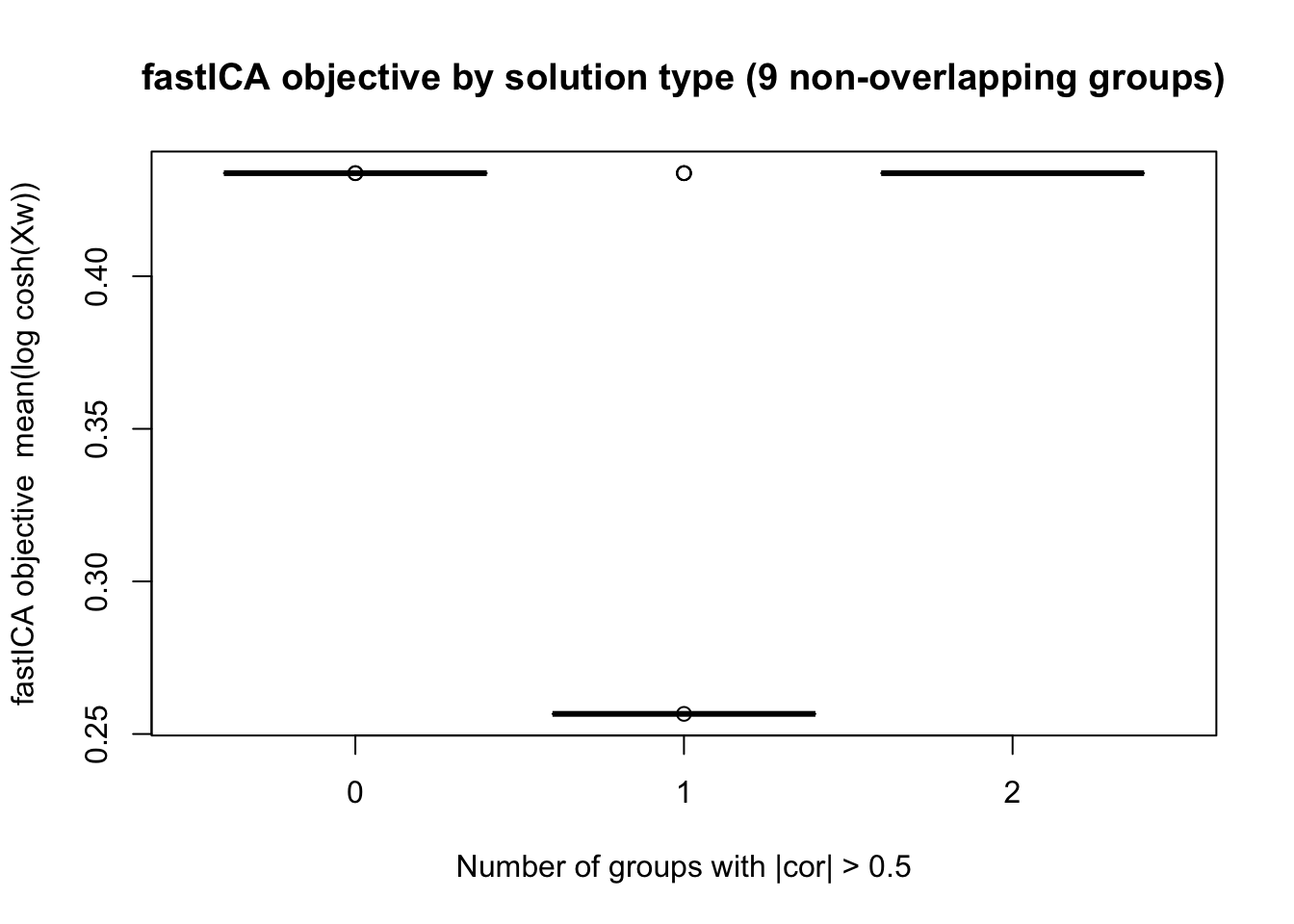
| Version | Author | Date |
|---|---|---|
| c43e3ef | Matthew Stephens | 2026-08-15 |
Heatmap of absolute correlations for each start (rows = starts sorted by best single-group correlation, columns = true groups):
par(mfrow = c(1, 2))
order_ica <- order(apply(cor_ica, 1, max), decreasing = TRUE)
image(t(cor_ica[order_ica, ]), zlim = c(0, 1), axes = FALSE,
main = "fastICA", xlab = "True group", ylab = "Start (sorted)")
axis(1, at = seq(0, 1, length.out = 9), labels = 1:9)
order_ap <- order(apply(cor_ap, 1, max), decreasing = TRUE)
image(t(cor_ap[order_ap, ]), zlim = c(0, 1), axes = FALSE,
main = "AltProj", xlab = "True group", ylab = "Start (sorted)")
axis(1, at = seq(0, 1, length.out = 9), labels = 1:9)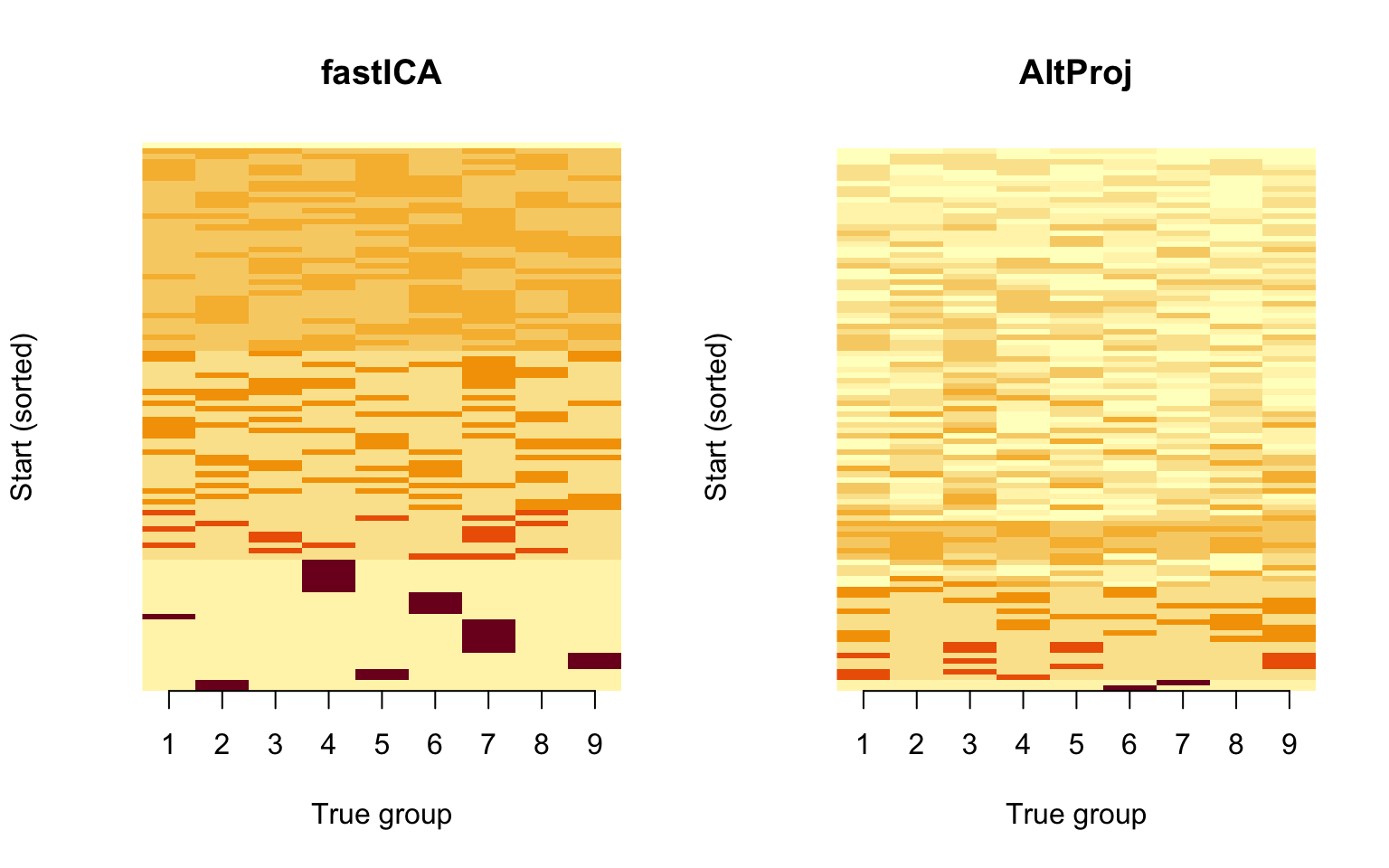
| Version | Author | Date |
|---|---|---|
| c43e3ef | Matthew Stephens | 2026-08-15 |
par(mfrow = c(1, 1))Diagnosing the 3 overlapping groups case
AltProj achieves a higher mean v’Pv than fastICA in this setting despite a much lower success rate, suggesting it is finding high-energy binary vectors that do not isolate single groups.
K <- 3; p <- 1000; n <- 100; n_starts <- 100; n_iter <- 50
set.seed(1)
L3 <- matrix(-1, nrow = n, ncol = K)
for (i in 1:K) L3[sample(1:n, 20), i] <- 1
FF <- matrix(rnorm(p * K), nrow = p, ncol = K)
X3 <- L3 %*% t(FF) + rnorm(n * p, 0, 0.01)
X1 <- preprocess(X3, n.comp = 10)
X1_aug <- rbind(rep(1, ncol(X1)), X1)
# fastICA
set.seed(1)
W <- matrix(rnorm(nrow(X1_aug) * n_starts), nrow(X1_aug), n_starts)
W <- sweep(W, 2, sqrt(colSums(W^2)), "/")
for (i in seq_len(n_iter)) W <- fastica_update(X1_aug, W)
Lhat_ica <- t(X1_aug) %*% W
# alt_proj
set.seed(1)
V <- sign(matrix(rnorm(n * n_starts), n, n_starts))
V[V == 0] <- 1L
for (i in seq_len(n_iter)) V <- alt_proj_update(X1_aug, V)
Lhat_ap <- V
cor_ica <- abs(cor(Lhat_ica, L3)) # n_starts x 3
cor_ap <- abs(cor(Lhat_ap, L3))Warning in cor(Lhat_ap, L3): the standard deviation is zeropar(mfrow = c(1, 2))
order_ica <- order(apply(cor_ica, 1, max), decreasing = TRUE)
image(t(cor_ica[order_ica, ]), zlim = c(0, 1), axes = FALSE,
main = "fastICA", xlab = "True group", ylab = "Start (sorted)")
axis(1, at = seq(0, 1, length.out = 3), labels = 1:3)
order_ap <- order(apply(cor_ap, 1, max), decreasing = TRUE)
image(t(cor_ap[order_ap, ]), zlim = c(0, 1), axes = FALSE,
main = "AltProj", xlab = "True group", ylab = "Start (sorted)")
axis(1, at = seq(0, 1, length.out = 3), labels = 1:3)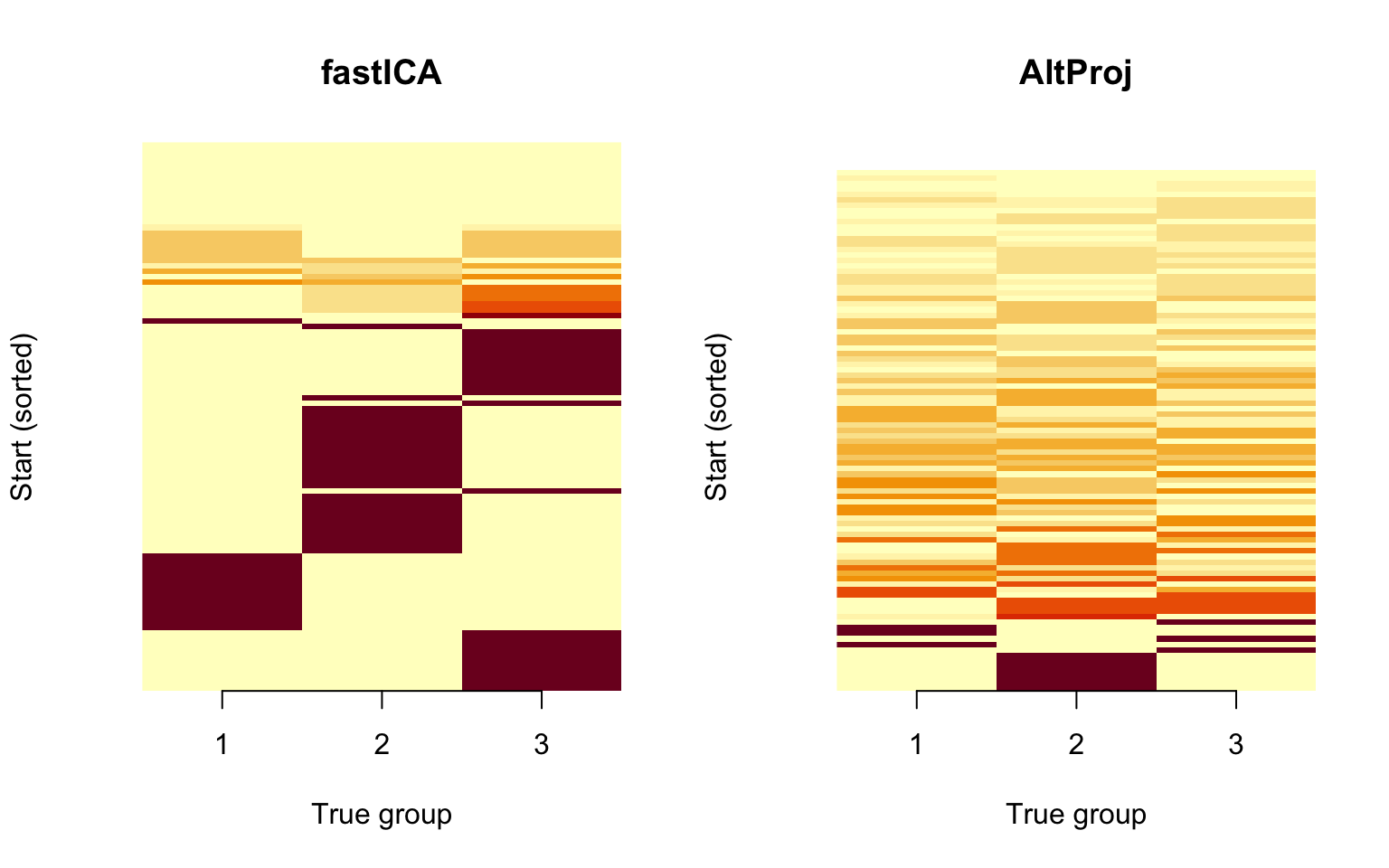
| Version | Author | Date |
|---|---|---|
| f5ac45b | Matthew Stephens | 2026-08-15 |
par(mfrow = c(1, 1))Simulation 6: 25 non-overlapping groups
Twenty-five equal non-overlapping groups of 20 (n=500). Using n.comp=25.
n <- 500; p <- 1000
set.seed(1)
L <- matrix(0, nrow = n, ncol = 25)
for (i in 1:25) { L[((i - 1) * 20 + 1):(i * 20), i] <- 1 }
FF <- matrix(rnorm(p * 25), nrow = p)
X <- L %*% t(FF) + rnorm(n * p, 0, 0.01)
res6 <- run_comparison(X, L, n.comp = 25, label = "25 non-overlapping groups (n=500)")Running fastICA for: 25 non-overlapping groups (n=500)
Running fastICA-hybrid for: 25 non-overlapping groups (n=500)
Running alt-proj for: 25 non-overlapping groups (n=500)
ICA: approx=45% exact=45% degen=0% Hybrid: approx=0% exact=0% degen=0% AP: approx=0% exact=0% degen=0%Summary
results <- data.frame(
Simulation = c(
"3 overlapping groups (n=100)",
"9 overlapping groups (n=100)",
"4 non-overlapping groups (n=100)",
"9 non-overlapping groups (n=225)",
"Bifurcating tree (n=100, 6 branches)",
"25 non-overlapping groups (n=500)"
),
n.comp = c(10, 10, 10, 20, 10, 25),
p = c("0.20", "0.20", "0.25", "0.11", "0.25-0.50", "0.04"),
fastICA_exact = round(100 * c(res1["fastICA_exact"], res2["fastICA_exact"], res3["fastICA_exact"],
res4["fastICA_exact"], res5["fastICA_exact"], res6["fastICA_exact"])),
Hybrid_exact = round(100 * c(res1["Hybrid_exact"], res2["Hybrid_exact"], res3["Hybrid_exact"],
res4["Hybrid_exact"], res5["Hybrid_exact"], res6["Hybrid_exact"])),
AltProj_exact = round(100 * c(res1["AltProj_exact"], res2["AltProj_exact"], res3["AltProj_exact"],
res4["AltProj_exact"], res5["AltProj_exact"], res6["AltProj_exact"])),
fastICA_degen = round(100 * c(res1["fastICA_degen"], res2["fastICA_degen"], res3["fastICA_degen"],
res4["fastICA_degen"], res5["fastICA_degen"], res6["fastICA_degen"])),
Hybrid_degen = round(100 * c(res1["Hybrid_degen"], res2["Hybrid_degen"], res3["Hybrid_degen"],
res4["Hybrid_degen"], res5["Hybrid_degen"], res6["Hybrid_degen"])),
AltProj_degen = round(100 * c(res1["AltProj_degen"], res2["AltProj_degen"], res3["AltProj_degen"],
res4["AltProj_degen"], res5["AltProj_degen"], res6["AltProj_degen"])),
fastICA_ms = round(c(res1["fastICA_ms"], res2["fastICA_ms"],
res3["fastICA_ms"], res4["fastICA_ms"], res5["fastICA_ms"], res6["fastICA_ms"])),
Hybrid_ms = round(c(res1["Hybrid_ms"], res2["Hybrid_ms"],
res3["Hybrid_ms"], res4["Hybrid_ms"], res5["Hybrid_ms"], res6["Hybrid_ms"])),
AltProj_ms = round(c(res1["AltProj_ms"], res2["AltProj_ms"],
res3["AltProj_ms"], res4["AltProj_ms"], res5["AltProj_ms"], res6["AltProj_ms"])),
fastICA_beat = round(100 * c(res1["fastICA_beat"], res2["fastICA_beat"], res3["fastICA_beat"],
res4["fastICA_beat"], res5["fastICA_beat"], res6["fastICA_beat"])),
Hybrid_beat = round(100 * c(res1["Hybrid_beat"], res2["Hybrid_beat"], res3["Hybrid_beat"],
res4["Hybrid_beat"], res5["Hybrid_beat"], res6["Hybrid_beat"])),
AltProj_beat = round(100 * c(res1["AltProj_beat"], res2["AltProj_beat"], res3["AltProj_beat"],
res4["AltProj_beat"], res5["AltProj_beat"], res6["AltProj_beat"])),
true_vPv = round(c(res1["true_vPv"], res2["true_vPv"], res3["true_vPv"],
res4["true_vPv"], res5["true_vPv"], res6["true_vPv"]), 4)
)
knitr::kable(results,
col.names = c("Simulation", "n.comp", "p",
"ICA >0.99", "Hyb >0.99", "AP >0.99",
"ICA degen%", "Hyb degen%", "AP degen%",
"ICA (ms)", "Hyb (ms)", "AP (ms)",
"ICA % ≥ v'Pv", "Hyb % ≥ v'Pv", "AP % ≥ v'Pv",
"True min v'Pv"),
caption = "Per-start success rates for fastICA (Newton), Hybrid (5 gradient + 45 Newton steps), and AltProj, at two correlation thresholds; percentage of degenerate solutions; wall-clock time; and fraction of starts whose binarized v'Pv meets or exceeds the minimum true group v'Pv."
)| Simulation | n.comp | p | ICA >0.99 | Hyb >0.99 | AP >0.99 | ICA degen% | Hyb degen% | AP degen% | ICA (ms) | Hyb (ms) | AP (ms) | ICA % <U+2265> v’Pv | Hyb % <U+2265> v’Pv | AP % <U+2265> v’Pv | True min v’Pv |
|---|---|---|---|---|---|---|---|---|---|---|---|---|---|---|---|
| 3 overlapping groups (n=100) | 10 | 0.20 | 68 | 58 | 13 | 15 | 10 | 5 | 20 | 17 | 11 | 68 | 58 | 18 | 100.0000 |
| 9 overlapping groups (n=100) | 10 | 0.20 | 84 | 65 | 17 | 6 | 7 | 0 | 9 | 10 | 6 | 84 | 65 | 17 | 100.0000 |
| 4 non-overlapping groups (n=100) | 10 | 0.25 | 41 | 48 | 9 | 16 | 13 | 3 | 10 | 10 | 6 | 41 | 48 | 12 | 100.0000 |
| 9 non-overlapping groups (n=225) | 20 | 0.11 | 24 | 2 | 2 | 1 | 2 | 1 | 17 | 17 | 10 | 24 | 2 | 3 | 224.9999 |
| Bifurcating tree (n=100, 6 branches) | 10 | 0.25-0.50 | 63 | 54 | 11 | 10 | 12 | 5 | 10 | 10 | 6 | 63 | 54 | 16 | 100.0000 |
| 25 non-overlapping groups (n=500) | 25 | 0.04 | 45 | 0 | 0 | 0 | 0 | 0 | 35 | 36 | 26 | 45 | 0 | 0 | 499.9998 |
The Hybrid method performs noticeably worse than standard fastICA on non-overlapping group simulations (sims 3, 4, 6). The likely reason is that a binary vector indicating a single non-overlapping group is a minimum of the log-cosh contrast function: because the group members are all identical in whitened space, the projection has a highly sub-Gaussian (near-Bernoulli) distribution, which log-cosh penalises rather than rewards. The initial gradient-ascent steps therefore push the weight vector away from these solutions before Newton steps take over, leaving fewer starting points in the basin of attraction of the correct solution. The standard fastICA Newton steps, by contrast, can converge to both maxima and minima of the contrast, and apparently reach the non-overlapping group solutions more reliably from random initialisation.
High-noise simulations
We repeat all five simulations with noise_sd = 4 instead of 0.01, chosen so that the true v’Pv is around 90% of n.
Simulation 1: 3 overlapping groups (high noise)
K <- 3; p <- 1000; n <- 100
set.seed(1)
L <- matrix(-1, nrow = n, ncol = K)
for (i in 1:K) { L[sample(1:n, 20), i] <- 1 }
FF <- matrix(rnorm(p * K), nrow = p, ncol = K)
X <- L %*% t(FF) + rnorm(n * p, 0, 4)
nres1 <- run_comparison(X, L, n.comp = 10, label = "3 overlapping groups, high noise")Running fastICA for: 3 overlapping groups, high noise
Running fastICA-hybrid for: 3 overlapping groups, high noise
Running alt-proj for: 3 overlapping groups, high noise Warning in cor(v, L): the standard deviation is zero
Warning in cor(v, L): the standard deviation is zero
Warning in cor(v, L): the standard deviation is zero
Warning in cor(v, L): the standard deviation is zero
Warning in cor(v, L): the standard deviation is zero
Warning in cor(v, L): the standard deviation is zero
Warning in cor(v, L): the standard deviation is zero ICA: approx=65% exact=65% degen=18% Hybrid: approx=60% exact=60% degen=11% AP: approx=14% exact=14% degen=7%Simulation 2: 9 overlapping groups (high noise)
K <- 9; p <- 1000; n <- 100
set.seed(1)
L <- matrix(0, nrow = n, ncol = K)
for (i in 1:K) { L[sample(1:n, 20), i] <- 1 }
FF <- matrix(rnorm(p * K), nrow = p, ncol = K)
X <- L %*% t(FF) + rnorm(n * p, 0, 4)
nres2 <- run_comparison(X, L, n.comp = 10, label = "9 overlapping groups, high noise")Running fastICA for: 9 overlapping groups, high noise
Running fastICA-hybrid for: 9 overlapping groups, high noise
Running alt-proj for: 9 overlapping groups, high noise Warning in cor(v, L): the standard deviation is zero
Warning in cor(v, L): the standard deviation is zero ICA: approx=0% exact=0% degen=24% Hybrid: approx=0% exact=0% degen=12% AP: approx=7% exact=3% degen=2%Simulation 3: 4 non-overlapping groups (high noise)
n <- 100; p <- 1000
set.seed(1)
L <- matrix(0, nrow = n, ncol = 4)
L[1:25, 1] <- 1; L[26:50, 2] <- 1; L[51:75, 3] <- 1; L[76:100, 4] <- 1
FF <- matrix(rnorm(p * 4), nrow = p)
X <- L %*% t(FF) + rnorm(n * p, 0, 4)
nres3 <- run_comparison(X, L, n.comp = 10, label = "4 non-overlapping groups, high noise")Running fastICA for: 4 non-overlapping groups, high noise
Running fastICA-hybrid for: 4 non-overlapping groups, high noise
Running alt-proj for: 4 non-overlapping groups, high noise Warning in cor(v, L): the standard deviation is zero
Warning in cor(v, L): the standard deviation is zero
Warning in cor(v, L): the standard deviation is zero
Warning in cor(v, L): the standard deviation is zero
Warning in cor(v, L): the standard deviation is zero ICA: approx=0% exact=0% degen=16% Hybrid: approx=0% exact=0% degen=14% AP: approx=6% exact=5% degen=5%Simulation 4: 9 non-overlapping groups (high noise)
n <- 225; p <- 1000
set.seed(1)
L <- matrix(0, nrow = n, ncol = 9)
for (i in 1:9) { L[((i - 1) * 25 + 1):(i * 25), i] <- 1 }
FF <- matrix(rnorm(p * 9), nrow = p)
X <- L %*% t(FF) + rnorm(n * p, 0, 4)
nres4 <- run_comparison(X, L, n.comp = 20, label = "9 non-overlapping groups, high noise")Running fastICA for: 9 non-overlapping groups, high noise
Running fastICA-hybrid for: 9 non-overlapping groups, high noise
Running alt-proj for: 9 non-overlapping groups, high noise Warning in cor(v, L): the standard deviation is zero ICA: approx=0% exact=0% degen=2% Hybrid: approx=0% exact=0% degen=2% AP: approx=2% exact=2% degen=1%Simulation 5: Bifurcating tree (high noise)
n <- 100; p <- 1000
set.seed(1)
L <- matrix(0, nrow = n, ncol = 6)
L[1:50, 1] <- 1; L[51:100, 2] <- 1
L[1:25, 3] <- 1; L[26:50, 4] <- 1; L[51:75, 5] <- 1; L[76:100, 6] <- 1
FF <- matrix(rnorm(p * 6), nrow = p)
X <- L %*% t(FF) + rnorm(n * p, 0, 4)
nres5 <- run_comparison(X, L, n.comp = 10, label = "Bifurcating tree, high noise")Running fastICA for: Bifurcating tree, high noise
Running fastICA-hybrid for: Bifurcating tree, high noise
Running alt-proj for: Bifurcating tree, high noise Warning in cor(v, L): the standard deviation is zero
Warning in cor(v, L): the standard deviation is zero
Warning in cor(v, L): the standard deviation is zero
Warning in cor(v, L): the standard deviation is zero ICA: approx=36% exact=11% degen=16% Hybrid: approx=45% exact=19% degen=16% AP: approx=7% exact=7% degen=4%Simulation 6: 25 non-overlapping groups (high noise)
n <- 500; p <- 1000
set.seed(1)
L <- matrix(0, nrow = n, ncol = 25)
for (i in 1:25) { L[((i - 1) * 20 + 1):(i * 20), i] <- 1 }
FF <- matrix(rnorm(p * 25), nrow = p)
X  <- L %*% t(FF) + rnorm(n * p, 0, 4)

nres6 <- run_comparison(X, L, n.comp = 25, label = "25 non-overlapping groups, high noise")
Running fastICA for: 25 non-overlapping groups, high noise
Running fastICA-hybrid for: 25 non-overlapping groups, high noise
Running alt-proj for: 25 non-overlapping groups, high noise Warning in cor(v, L): the standard deviation is zero
Warning in cor(v, L): the standard deviation is zero ICA: approx=0% exact=0% degen=21% Hybrid: approx=0% exact=0% degen=34% AP: approx=0% exact=0% degen=2%Summary (high noise)
nresults <- data.frame(
  Simulation = c(
    "3 overlapping groups (n=100)",
    "9 overlapping groups (n=100)",
    "4 non-overlapping groups (n=100)",
    "9 non-overlapping groups (n=225)",
    "Bifurcating tree (n=100, 6 branches)",
    "25 non-overlapping groups (n=500)"
  ),
  n.comp = c(10, 10, 10, 20, 10, 25),
  p = c("0.20", "0.20", "0.25", "0.11", "0.25-0.50", "0.04"),
  fastICA_exact  = round(100 * c(nres1["fastICA_exact"],  nres2["fastICA_exact"],  nres3["fastICA_exact"],
                                  nres4["fastICA_exact"],  nres5["fastICA_exact"],  nres6["fastICA_exact"])),
  Hybrid_exact   = round(100 * c(nres1["Hybrid_exact"],   nres2["Hybrid_exact"],   nres3["Hybrid_exact"],
                                  nres4["Hybrid_exact"],   nres5["Hybrid_exact"],   nres6["Hybrid_exact"])),
  AltProj_exact  = round(100 * c(nres1["AltProj_exact"],  nres2["AltProj_exact"],  nres3["AltProj_exact"],
                                  nres4["AltProj_exact"],  nres5["AltProj_exact"],  nres6["AltProj_exact"])),
  fastICA_degen  = round(100 * c(nres1["fastICA_degen"],  nres2["fastICA_degen"],  nres3["fastICA_degen"],
                                  nres4["fastICA_degen"],  nres5["fastICA_degen"],  nres6["fastICA_degen"])),
  Hybrid_degen   = round(100 * c(nres1["Hybrid_degen"],   nres2["Hybrid_degen"],   nres3["Hybrid_degen"],
                                  nres4["Hybrid_degen"],   nres5["Hybrid_degen"],   nres6["Hybrid_degen"])),
  AltProj_degen  = round(100 * c(nres1["AltProj_degen"],  nres2["AltProj_degen"],  nres3["AltProj_degen"],
                                  nres4["AltProj_degen"],  nres5["AltProj_degen"],  nres6["AltProj_degen"])),
  fastICA_ms     = round(c(nres1["fastICA_ms"], nres2["fastICA_ms"],
                            nres3["fastICA_ms"], nres4["fastICA_ms"], nres5["fastICA_ms"], nres6["fastICA_ms"])),
  Hybrid_ms      = round(c(nres1["Hybrid_ms"],  nres2["Hybrid_ms"],
                            nres3["Hybrid_ms"],  nres4["Hybrid_ms"],  nres5["Hybrid_ms"],  nres6["Hybrid_ms"])),
  AltProj_ms     = round(c(nres1["AltProj_ms"], nres2["AltProj_ms"],
                            nres3["AltProj_ms"], nres4["AltProj_ms"], nres5["AltProj_ms"], nres6["AltProj_ms"])),
  fastICA_beat   = round(100 * c(nres1["fastICA_beat"], nres2["fastICA_beat"], nres3["fastICA_beat"],
                                  nres4["fastICA_beat"], nres5["fastICA_beat"], nres6["fastICA_beat"])),
  Hybrid_beat    = round(100 * c(nres1["Hybrid_beat"],  nres2["Hybrid_beat"],  nres3["Hybrid_beat"],
                                  nres4["Hybrid_beat"],  nres5["Hybrid_beat"],  nres6["Hybrid_beat"])),
  AltProj_beat   = round(100 * c(nres1["AltProj_beat"], nres2["AltProj_beat"], nres3["AltProj_beat"],
                                  nres4["AltProj_beat"], nres5["AltProj_beat"], nres6["AltProj_beat"])),
  true_vPv       = round(c(nres1["true_vPv"], nres2["true_vPv"], nres3["true_vPv"],
                            nres4["true_vPv"], nres5["true_vPv"], nres6["true_vPv"]), 2)
)

knitr::kable(nresults,
  col.names = c("Simulation", "n.comp", "p",
                "ICA >0.99", "Hyb >0.99", "AP >0.99",
                "ICA degen%", "Hyb degen%", "AP degen%",
                "ICA (ms)", "Hyb (ms)", "AP (ms)",
                "ICA % ≥ v'Pv", "Hyb % ≥ v'Pv", "AP % ≥ v'Pv",
                "True min v'Pv"),
  caption   = "High-noise results (noise_sd = 4). Hybrid = 5 gradient + 45 Newton steps."
)| Simulation | n.comp | p | ICA >0.99 | Hyb >0.99 | AP >0.99 | ICA degen% | Hyb degen% | AP degen% | ICA (ms) | Hyb (ms) | AP (ms) | ICA % <U+2265> v’Pv | Hyb % <U+2265> v’Pv | AP % <U+2265> v’Pv | True min v’Pv |
|---|---|---|---|---|---|---|---|---|---|---|---|---|---|---|---|
| 3 overlapping groups (n=100) | 10 | 0.20 | 65 | 60 | 14 | 18 | 11 | 7 | 10 | 10 | 5 | 65 | 60 | 21 | 98.05 |
| 9 overlapping groups (n=100) | 10 | 0.20 | 0 | 0 | 3 | 24 | 12 | 2 | 10 | 9 | 5 | 0 | 0 | 15 | 85.69 |
| 4 non-overlapping groups (n=100) | 10 | 0.25 | 0 | 0 | 5 | 16 | 14 | 5 | 10 | 9 | 6 | 0 | 0 | 11 | 93.37 |
| 9 non-overlapping groups (n=225) | 20 | 0.11 | 0 | 0 | 2 | 2 | 2 | 1 | 18 | 17 | 10 | 0 | 0 | 3 | 208.78 |
| Bifurcating tree (n=100, 6 branches) | 10 | 0.25-0.50 | 11 | 19 | 7 | 16 | 16 | 4 | 10 | 9 | 6 | 27 | 36 | 11 | 94.11 |
| 25 non-overlapping groups (n=500) | 25 | 0.04 | 0 | 0 | 0 | 21 | 34 | 2 | 40 | 37 | 24 | 0 | 0 | 2 | 456.43 |
sessionInfo()R version 4.4.2 (2024-10-31)
Platform: aarch64-apple-darwin20
Running under: macOS 26.5.2
Matrix products: default
BLAS: /System/Library/Frameworks/Accelerate.framework/Versions/A/Frameworks/vecLib.framework/Versions/A/libBLAS.dylib
LAPACK: /Library/Frameworks/R.framework/Versions/4.4-arm64/Resources/lib/libRlapack.dylib; LAPACK version 3.12.0
locale:
[1] C
time zone: America/Chicago
tzcode source: internal
attached base packages:
[1] stats graphics grDevices utils datasets methods base
loaded via a namespace (and not attached):
[1] vctrs_0.7.2 cli_3.6.5 knitr_1.51 rlang_1.1.7
[5] xfun_0.56 stringi_1.8.7 otel_0.2.0 promises_1.5.0
[9] jsonlite_2.0.0 workflowr_1.7.2 glue_1.8.0 rprojroot_2.1.1
[13] git2r_0.36.2 htmltools_0.5.9 httpuv_1.6.16 sass_0.4.10
[17] rmarkdown_2.30 evaluate_1.0.5 jquerylib_0.1.4 tibble_3.3.1
[21] fastmap_1.2.0 yaml_2.3.12 lifecycle_1.0.5 whisker_0.4.1
[25] stringr_1.6.0 compiler_4.4.2 fs_1.6.6 Rcpp_1.1.1
[29] pkgconfig_2.0.3 later_1.4.6 digest_0.6.39 R6_2.6.1
[33] pillar_1.11.1 magrittr_2.0.4 bslib_0.10.0 tools_4.4.2
[37] cachem_1.1.0